If you've followed the build for a while, you know how much went into our 3rd gen Tacoma. The regear, the suspension, the bumper, the seats, the Alu-Cab Canopy Camper, the Goose Gear drawers, the wiring for every light and accessory. I did almost all of those installs myself in the driveway. So this one is hard to write.
At the end of May 2023 the Tacoma hydrolocked on a guided Mountain State Overland trip in southwest Virginia. Two weeks later the insurance company totaled it. This post covers what happened, what I think actually caused it, how we got the camper off a dead truck 200 miles from home, and what we're weighing for the next rig.
What happened
We were running a county road in southwest Virginia, right on the West Virginia border, on a guided trip. That weekend the county got enough rain to push some of the rivers to record levels. We heard the water came up something like 10 feet. There wasn't a ton of flash flood damage overall, but the county road we were on had a lot of water sitting on it.
We approached another big mud puddle. It was maybe 40 feet across and 60 feet long. It looked like 10 to 12 inches deep. I did what you're supposed to do. I stopped before the crossing and sized it up. I put it in 4 Low and turned the locker on just in case, and started through slow.
About two-thirds of the way across, the front end dropped into a small hole, maybe 3 inches deep, or went up and over a submerged rock. That was it. The engine shut off instantly, like someone had disconnected the battery. No sputtering, no warning. Luckily the body was completely out of the water at that point, so nothing got inside the cab.
I pulled the winch line out, but with the truck essentially dead I knew we weren't going to be able to run the winch at full power. One of the guests worked his way around me through the water, we hooked up my kinetic recovery rope, and he pulled me out.
We made it another half mile down the road to a spot where we could let Jason get around. He read the codes, which pointed to a bad mass air flow sensor in the airbox, and went off to track down the part. One of the guests then towed us to the end of the county road. On the way down the hill I cooked the brakes. I was able to stop and let them pull me down the rest of the way, but the brakes were smoking by the time we got to the bottom.
I spent that night in the parking lot at Tangent Outfitters, run by one of Jason's buddies, waiting on the part. The next morning Jason and the rest of the group came back to the gas station and we swapped in the new MAF sensor. It didn't fix anything, which, looking back, makes total sense.
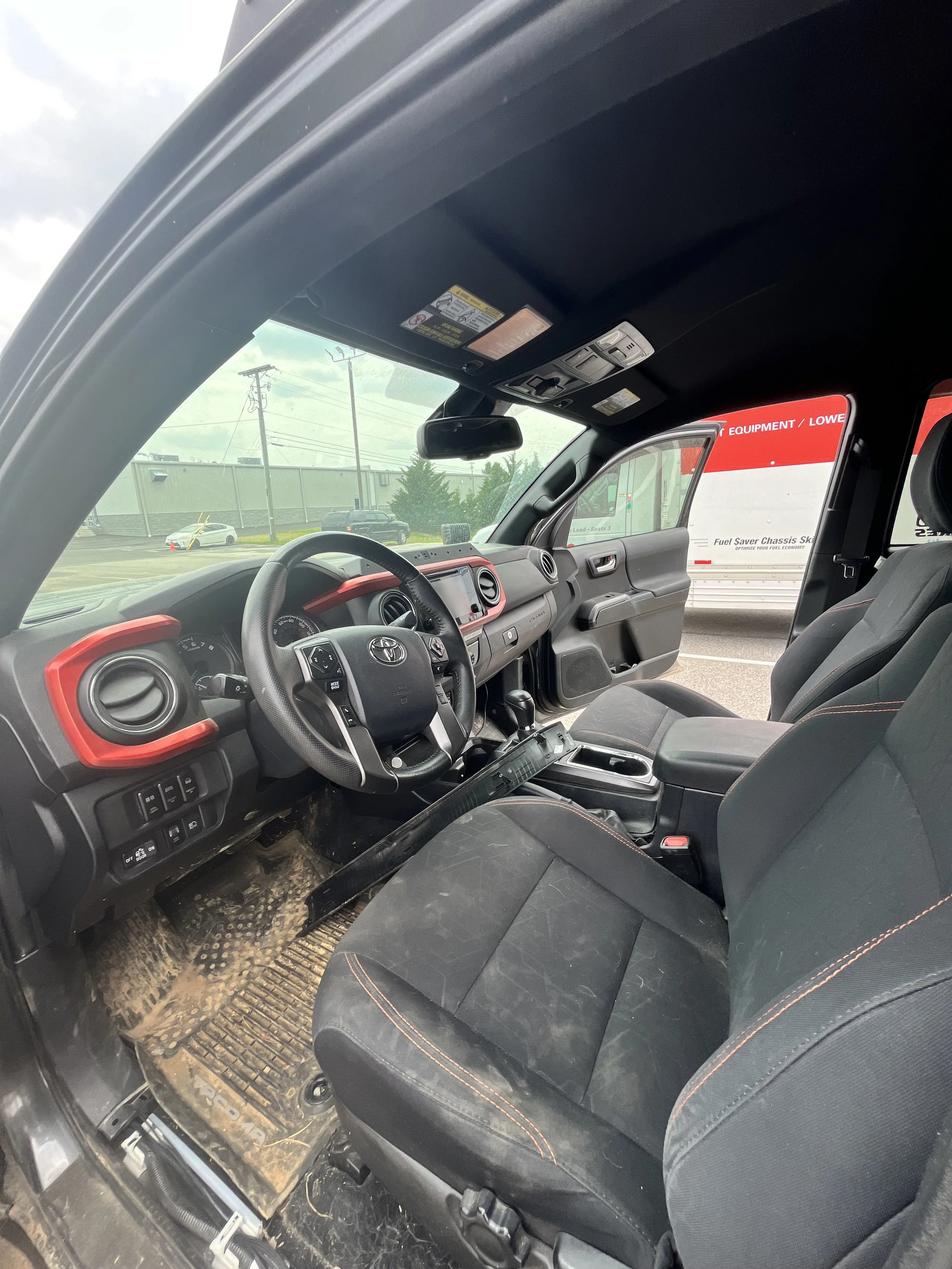
From there it got towed about 20 miles to Shelor Toyota in Christiansburg. They diagnosed a bad starter, replaced it, and then found the real problem: the engine was done. The repair estimate came in around $13,000. Once the insurance company figured they'd be replacing not just the engine but the transmission too, they called it a total loss.
What I think actually caused it
A puddle that deep shouldn't kill a Tacoma. Here's our best theory.
The airbox on the Tacoma sits right up in the driver's side fender well. My fender liner had been cut, and we think that opening funneled water straight up into the airbox when the truck dropped into that hole.
The bigger factor, I think, is that I had a K&N filter in the airbox instead of the factory Toyota paper filter, and I didn't have a snorkel. A K&N lets a lot more air through, which is the whole point. It also lets a lot more water through. I'm pretty sure the stock paper filter would have soaked up more of that water and kept it out of the engine.
It doesn't take much. When I talked to Toyota they said less than a cup of water is enough to destroy an engine like that.
Lessons learned
Don't run a K&N (or any oiled, high-flow filter) if you don't have a snorkel. There's a reason Toyota puts a paper filter in there.
Keep the engine and intake as stock as you can. Spend the money on the stuff that actually helps you off-road, not on squeezing a little more airflow out of the intake.
If your airbox lives in the fender well, a snorkel isn't optional. Whatever we end up driving next is getting one.
Check your fender liners. If you've trimmed them for tire clearance, think about where that opening sends water.
Water depth isn't the only number that matters. I judged the crossing right. A 3 inch hole I couldn't see is what did it.
Pay for the modifications endorsement on your insurance. I had it, and it's the only reason I'm not eating the cost of every part I bolted on.
Getting the camper off a dead truck
The truck died just outside Christiansburg, Virginia. We live about three hours away in North Carolina, so for two weeks the Tacoma sat 200 miles from home. Before I could sign it over to insurance, I had to get everything worth saving off of it, starting with the camper.
So I rented a U-Haul for 72 hours and drove up. When I pulled into the Shelor lot, the truck honestly looked great, apart from the blown engine.
Day 1: Stripping it down
My buddy John, who I've connected with at a few different events over the years, had been at a meetup in Roanoke and camped nearby the night before. He offered to come help strip the truck, at least to get the winch out. I didn't have a receipt for the winch, so that was coming home with me. All I could do was buy him lunch.
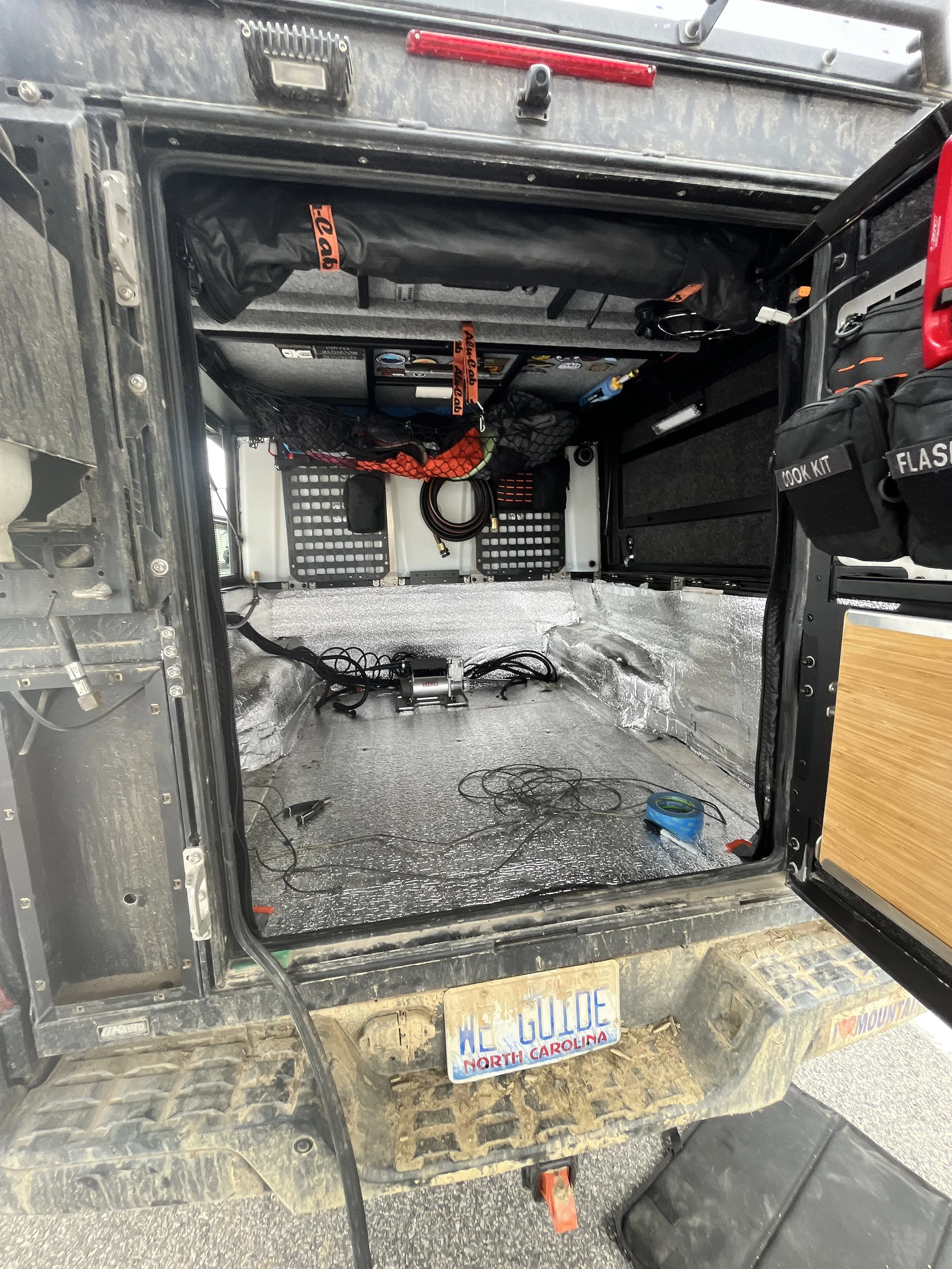
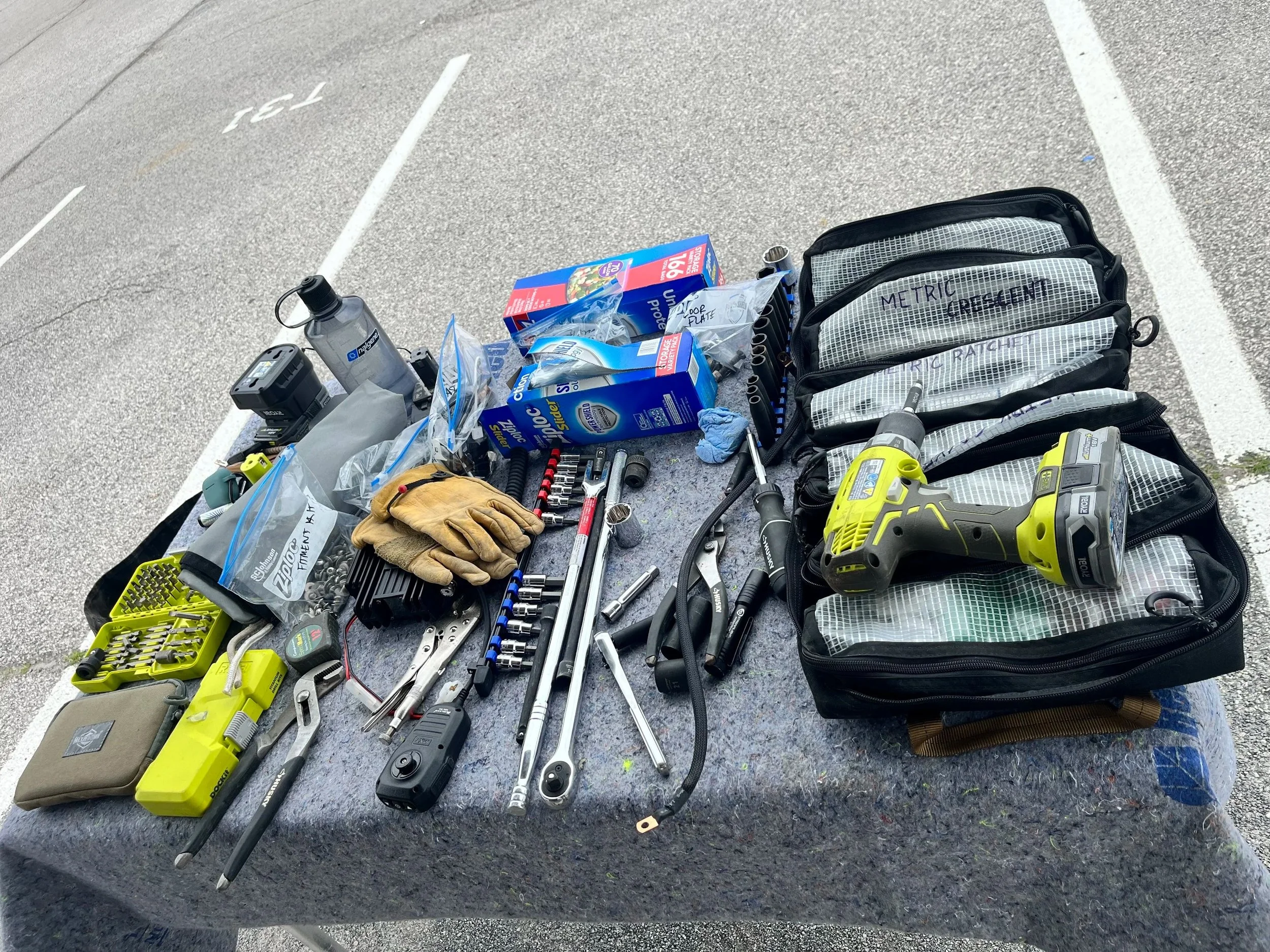
We started at 10 in the morning and pulled:
The Goose Gear drawer system and the fridge
All the camper wiring, bundled up with zip ties
The water tank and all the plumbing
The propane plumbing (the tank itself had to wait until the next day)
The winch
I also drilled out all of the rivets on the camper door frame so it could come out. I broke the gas strut in the process, but those are easy to replace. John headed out around 1:45, and by about 3:15 the camper was ready to come off and I was racing to get everything into the U-Haul before the rain hit.
Day 2: Forklifting it off
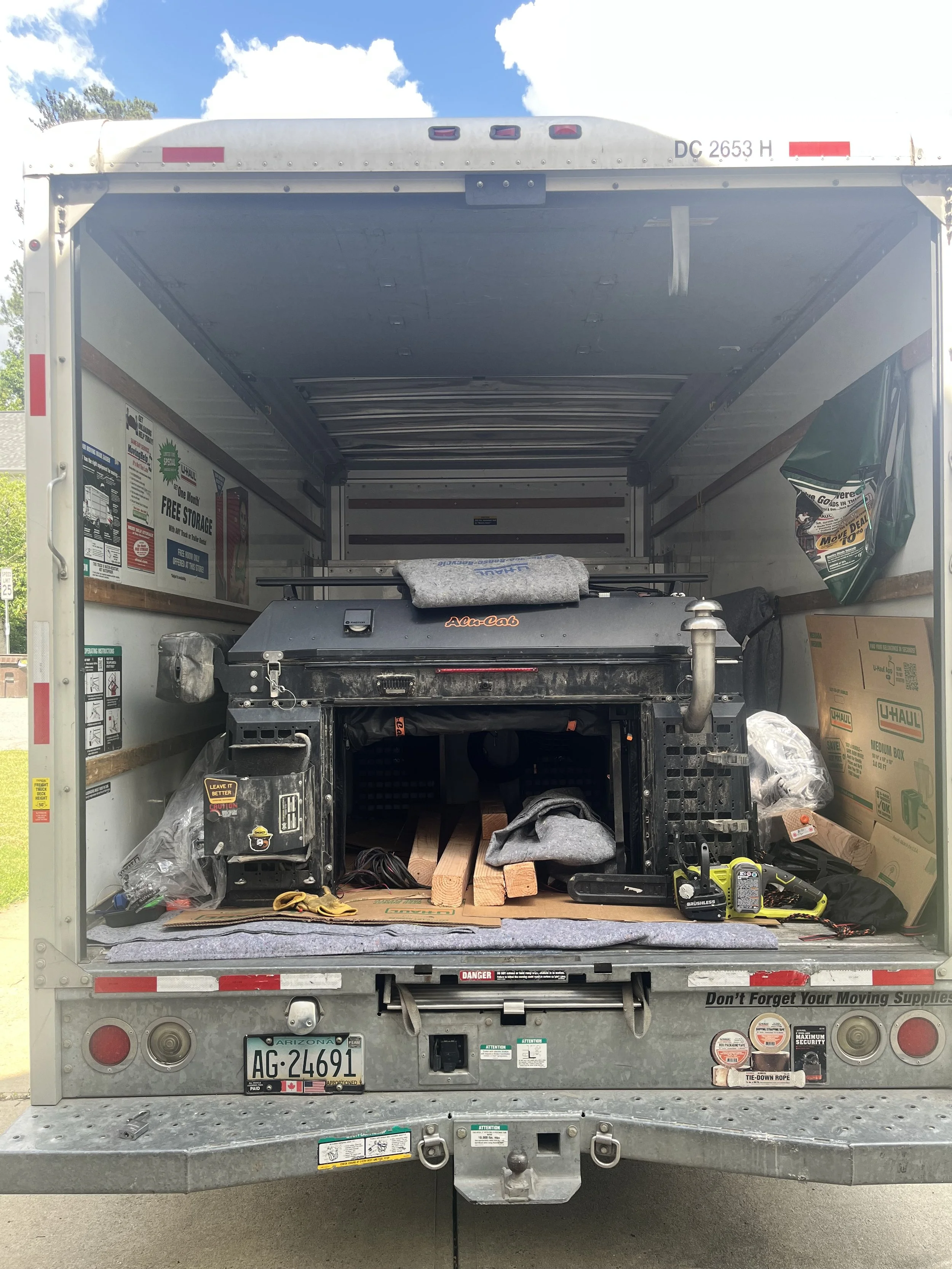
The next morning I took the door off and undid the stainless steel brackets that hold the camper to the bed. We cut some 2x lumber to span from one wiring channel to the other so the forks would have something solid to lift against.
Then Shelor brought out a loader with forks and lifted the whole camper straight up and off the truck. We slid it into the U-Haul, and that was that. The fitment kit, the insulation, and the trash all stayed with the truck.
I have to call out the team at Shelor Toyota here. Nikki and her supervisor Bobby were so helpful, so understanding, and so patient through all of this. Shelor is closed on Sundays, and Nikki came in anyway so I could work on the truck, then they had the forklift ready Monday morning. They really went above and beyond.
Before leaving I still had to settle the total amount with the insurance company and get them to agree on the value of the modifications. The hope was to get that done before they took possession of the truck from Shelor.
And a huge thank you to Jason, Ben, and the rest of the MSO crew, plus everyone who reached out on social media and all of our friends back home. Everyone knows how much time and effort went into that truck.
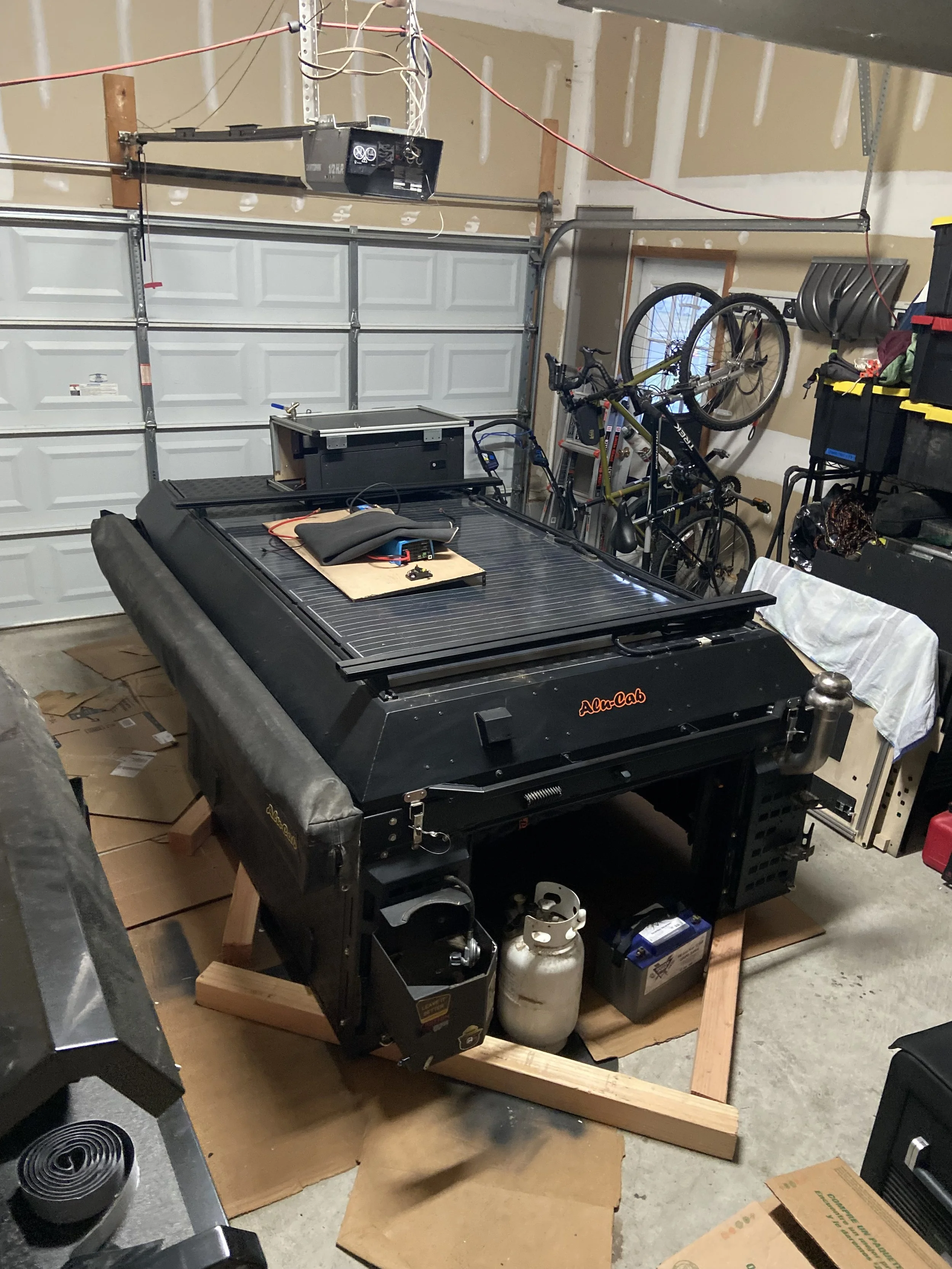
The hard part
The insurance payout covers parts. It doesn't cover labor, and I did almost every install on that truck myself. Apex Overland did the initial suspension work and I had a hand getting the camper on, but the camper outfitting, the diff breather, the wiring for the camper and all the lights, all of that was me. There's no way to put a number on those hours, and the insurance company obviously doesn't try.
It was a really crappy couple of weeks. A sad day, but hopefully it leads to bigger and better things.
What's next: the options
Here's how I was thinking about it at the time.
1. Buy the truck back as salvage. Probably not. Getting a salvage vehicle back on the road in North Carolina means jumping through a lot of hoops, and with a full-time job and not an endless amount of capital, I don't have the time or money to turn a salvage title into a rebuilt one. A rebuilt-title truck would also be worth about half what it would be otherwise. We need something reliable.
2. Wait for the new 2024 Tacoma. Everyone's going to ask. It's interesting, but I'm expecting an off-road trim to land around $55,000 to $60,000, and I don't think we'll see the hybrid for another year. The aftermarket will be thin for a year or two, and that includes Alu-Cab. It's an entirely new bed with taller bedsides, so my current fitment kit won't work. Doesn't make sense unless I want to wait and spend more.
3. Buy a new 2023 Tacoma and rebuild. Keep the camper, the Goose Gear, and all the internals and just rebuild the truck. I doubt the insurance money covers both a new truck and a rebuild, so we'd be taking on some cost, plus a new fitment kit since I'm not pulling the old one off the totaled truck.
4. Something other than a Tacoma. Rachael drove a Colorado ZR2. It's nice, but it's missing a lot of the safety features we got used to in the Taco: blind spot monitoring, adaptive cruise, parking sensors. It's just a truck, and it still has a key. Good option if we don't want to do much building. We also have the chance to buy a fully built, used AEV Bison, which we're honestly leaning toward. And we're going to look at Ford Rangers.
5. Go full size. We test drove a Tundra. Going full size means selling the camper, using something else for MSO trips, especially the guided ones, and delaying any build because we'd have to pay for the truck first.
Part of why we're even considering something bigger is that the midsize Tacoma was just a little too small for me, Rachael, and the two dogs. If we're going to take on extra work and money, it would be to apply that lesson.
Where I landed for now: a fully built used AEV Bison, or a new 2023 Tacoma if we can get a great deal and put the insurance settlement toward it plus some of the rebuild.
Up next
If you've read the 2021 Tundra build series, you already know how this ended. That's where the story picks up.
And if you want to see a rig like this on the trail (hopefully with a snorkel), come join us on a Mountain State Overland guided trip.